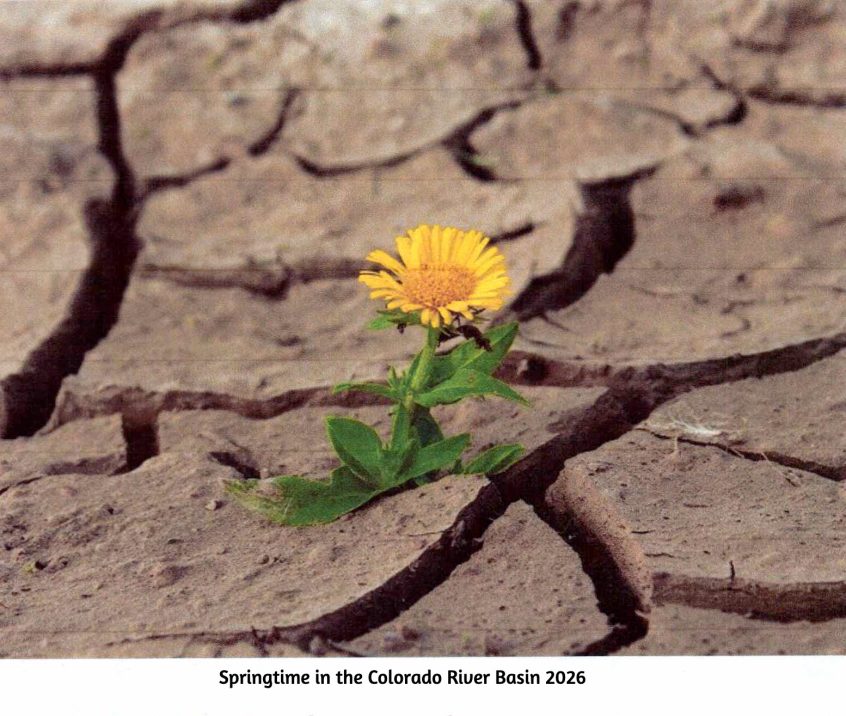
A bad year in the Colorado River Basin – barring a truly miraculous spring, probably the worst in recorded history. It is bad enough so the Bureau may have to stop creating power from the Glen Canyon powerplant by this coming fall. At that point, the only way to get water downriver from Glen Canyon Dam will be dribbling it through four outlet tubes that the Bureau is now wishing it had built differently (better) 65 years ago. And praying for enough precip to push the level back above the danger point for the turbines. Meanwhile the negotiations between the seven basin states about the future distribution of the water remained at an impasse. One might think that a really bad year might generate some new thinking, but the two Basins are still debating Compact numbers like 7.5 million acre-feet for the Lower Basin with a river that might produce less than 5 maf this year, and maybe not much … Read More
Romancing the River: The Era of Conquest Part 2
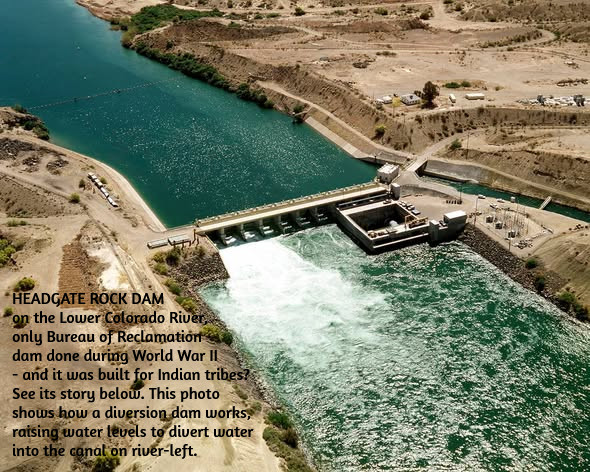
The hard news about the Colorado River since my last post here is not good; we had a storm that dropped around two feet of snow above the 8,000-foot elevation – well, maybe the 9,000-foot elevation. But that was followed by a couple weeks of ridiculously warm weather for February and early March, with more 50-degree weather forecast into the near future, and overnight lows often in the 20s, rather than down around zero. Forecasts for the runoff this year range around a third of the ‘historic normal,’ which is an increasingly meaningless number – and dangerous too, MAGA-thinking, keeping alive the hope that eventually the Colorado River will be great again if we just wait it out, or close our eyes and wish real hard, with real violence toward realists…. The Bureau bases its ‘averages’ on the recent 30-year average going by decades – so now the ‘long-term average’ is based on 1991-2020. Back as recently as 2019, it … Read More
Romancing the River – The Romance of Conquest, Part 1

We’re an empire now, and when we act, we create our own reality. – Senior advisor to Pres. G. W. Bush, 2004 You’ve seen that quote here before – and you’ll probably see it again; if this were a Wagnerian opera, that line would be a lietmotif, a recurring musical thread associated with a particular character or place or idea in the story being told musically. And who’s to say, ‘The Romance of the Colorado River,’ Frederick Dellenbaugh’s title, might make a grand opera. But before launching into the next chapter in the ‘Romance of the Colorado River,’ there are some items of news to note. The no-news item of course continues to be the ongoing stalemate in the ongoing negotiations between the Upper and Lower Colorado River Basins. On the eve of their Valentine’s Day deadline, there is talk of new ‘interim interim guidelines,’ two to five years, for at least a nominal state presence as the Bureau of … Read More
Romancing the River: The Romantic Scientist

There continues to be no new information from the ongoing negotiations among the protagonists for the seven states trying to work out a new two-basin management plan for the Colorado River. The Bureau of Reclamation, however, is pressing ahead; it recently went public with its ‘Draft Environmental Impact Statement’ (DEIS) for ‘Post-2026 Operational Guidelines and Strategies for Lake Powell and Lake Mead.’ The five alternative ‘operational guidelines and strategies’ analyzed in this DEIS were announced back in the fall of 2024; the Bureau has spent the past year-plus examining their environmental impacts. I’m not going to go into their analyses right now; I’m still working on skimming, skipping, sprinting and plowing my way through enough of the 1600 pages or so of the report to feel reasonably informed on its contents. But I will note that the first action analyzed (skipping past the mandatory ‘No Action’ alternative) is for the Bureau to go ahead and run the river system as … Read More
Romancing the River: Dancing with Deadpool
‘Dancing with Deadpool’ – Doesn’t that sound like something a romantic like me would concoct? I was intending for this post to be a follow-up on the last post, laying out my rationale for believing that we have all been ‘romancing the Colorado River’ for a century and a half, with three distinct epochs. But then ‘Dancing with Deadpool’ came along. ‘Dancing with Deadpool’ is actually the title of a report recently released by a Colorado River Research Group, a group of natural and social scientists presenting under the auspices of the Getches-Wilkinson Law Center at the University of Colorado. They are ‘all academics with long, well-established involvement in Colorado River scholarship,’ and you’ve heard about the work of a number of them in these posts before – Brad Udall, Eric Kuhn, Jack Schmidt, Ann Castle, Doug Kenney, among others. In ‘Dancing with Deadpool’ they were invited ‘to present their thoughts on the future of the Colorado River as individuals … Read More
Romancing the River: Why am I ‘Romancing’ It?
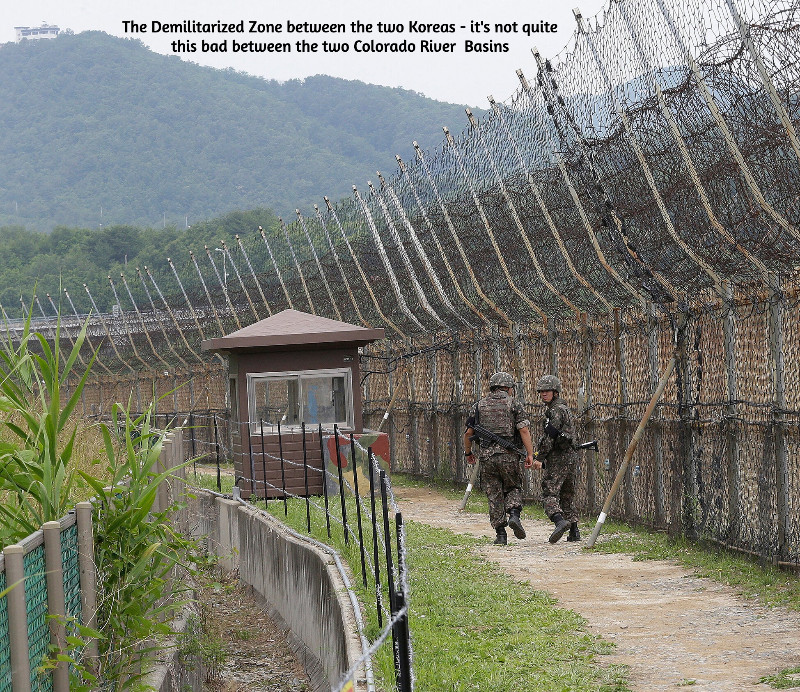
A vein of romance runs through every form of human endeavor. – C.J. Blanchard Negotiations among the Magnificent Seven representing the seven states of the Colorado River region begin to resemble the ongoing negotiations between the military and diplomatic representatives for North and South Korea, where negotiations for something beyond an armistice have been going on for more than sixty years. Here, as there, the negotiations have reached a stalemate, and both sides are now engaged in an information war. Between the two Koreas, this war takes the form of everything from huge arrays of speakers blasting pop music across the demilitarized zone to smuggled USB drives with movies and TV shows. Here, it is mostly just propaganda bombs tossed over our ‘DMZ,’ the Grand Canyons, about each side’s virtue and the other side’s obstinacy, depending on their regional media’s love of conflict and tendency to support the home team. The missed November deadline has been seamlessly replaced – as … Read More
Revisiting the Near Past
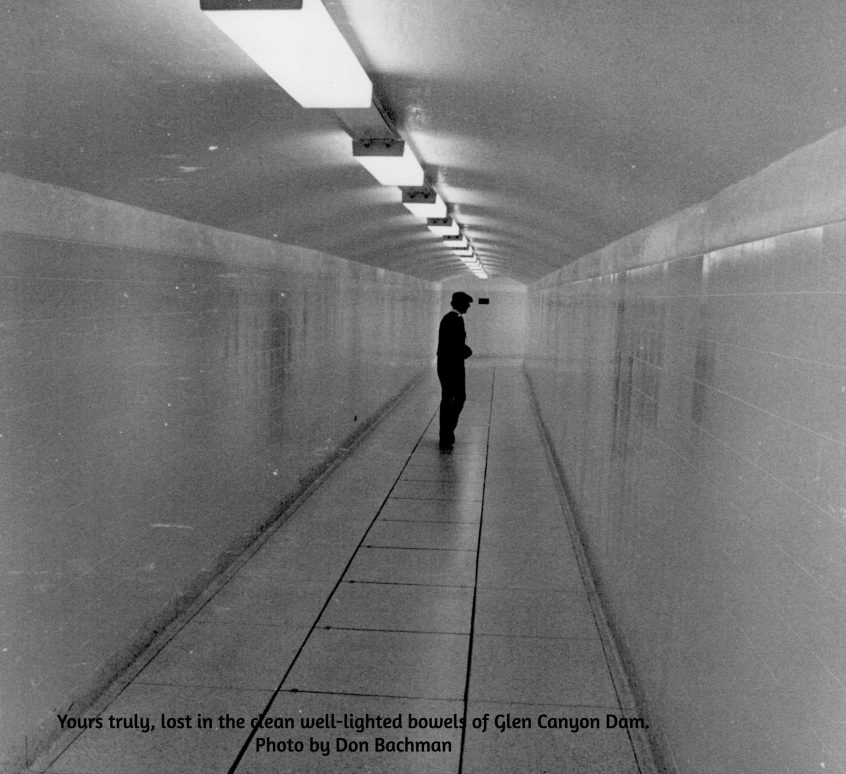
The Bureau of Reclamation’s November 11 deadline for the seven states to present a plan for the management of the Colorado River has passed with no white smoke from the chimney – no smoke at all in fact, black or white; the meetings have been so secretive that one wonders if the Magnificent Seven have really been meeting at all. So there being no news on that front, rather than adding to the copious media analysis of no news, I’m going to step back for the usual longer look – this time backward, to acknowledge an anniversary: this post marks the completion of the fourth year of this ongoing commentary on our lives with our rivers, mostly the Colorado River; the first post was November 22, 2021. About that, I’ll just say I’ve enjoyed this, and learned a lot on top of what I already knew about the river, hydrology, riparian sociology and economy, et cetera; and I do appreciate … Read More
Romancing the River: In Pursuit of the Real 1922 Compact
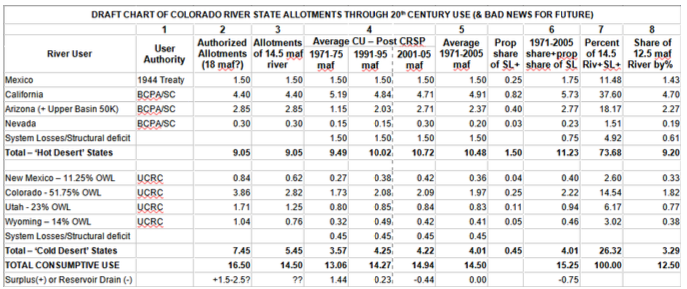
Wonk warning: I’ll be explicating the chart above. If this sort of thing bores you, or just gets you more, not less confused about what’s going on with the river today as the negotiators for post-2026 system management continue to negotiate with a November 11 deadline, then I’d say take a break until next post, when I’m going to try to explain why I call this stuff ‘Romancing the River.’ For those reading on here, remember my purpose from earlier posts: to show a reasonably equitable division of the consumptive use of the Colorado River waters among the seven states and Mexico, with no ‘temporary’ division into competitive Upper and Lower Basins – the Compact they really wanted to do in 1922. I present the table above as just a draft effort in that direction; there will be arguments about some of the specific figures, but the method to the madness might have some merit. All the consumptive use information … Read More
Romancing the River: Why not do the Compact now they wanted to do in 1922?

Hard times in the Colorado River region. A near-average snowpack dissipated into an inflow into Powell Reservoir of only 40 percent of average; dry soils in the headwaters and high deserts, and increased evaporation and plant transpiration in a warming world are taking big tolls. And the negotiators for the seven Basin states, trying to work out a river management plan to replace the failing current management strategies, with the 30 Indian nations and Mexico looking over their shoulders, are continuing to… negotiate. Trump’s Interior Department officials have given then until November to negotiate a draft plan for beyond 2026. Meanwhile the Bureau of Reclamation has issued its annual 24-month projection, and it has no good news. Its worst case scenario – the one everyone looks at – suggests that, barring a huge winter this year, Powell Reservoir might drop to the elevation at which it can no longer produce hydropower by late fall 2026 – at which point it … Read More
Romancing the River We Have – sort of….
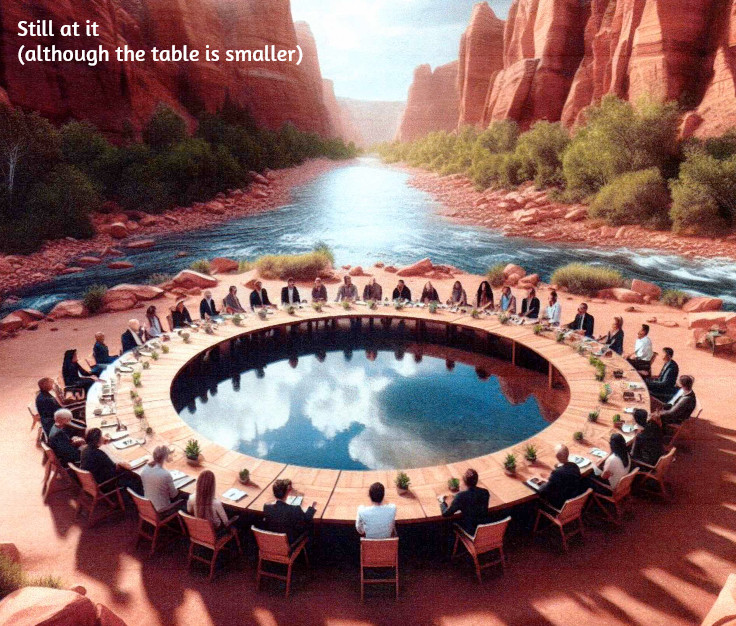
We left the Colorado River a couple months ago to explore the Trumpsters’ effort to use the public lands in the river basin to ‘unleash American energy’ and return us to the glorious age of cheap petroleum – and why it’s not happening. At that time, the seven states in the river’s basin were in a stalemate over a management plan to replace the cobbled together ‘interim’ management guidelines that expire next year. The Trumpsters’ have not interceded noticeably in this situation, since it appears to require complex and sustained thought. Unfortunately, the stalemate is still the basic situation. As a couple water mavens put it, we’re all still waiting for the black smoke coming out of the chimney to turn white. The Basin’s state representatives are meeting together regularly though, with input from the First People, and reports from the meetings suggest that the participants have all agreed to ‘work with the river we have, not the river we … Read More