Every so often it just seems like a good idea to drop out of the wrangling over the future of water in the arid west and – just go down to the river itself. A good friend abetted this by taking me along on a float down the lower Gorge of the Gunnison River. My friend was fishing; I was just along for the ride, and reflecting on my 60th anniversary of first moving to the Gunnison River valleys and the Colorado River Basin in 1966.
The Gunnison Gorge is a Bureau of Land Management Wilderness Area just downstream from the Black Canyon of the Gunnison River National Park. In 1966 I was – typically for a posturban American – unaware of where in the world I was, and didn’t know that the Gunnison River is one of the larger tributaries of the Colorado River, meeting the river in Grand Junction, Colorado, with a median contribution there of around 1.5 million acre-feet of water, with around another million acre-feet consumed by users in the Gunnison Basin, mostly for agriculture. This year, the river carries a fraction of that, less than a fourth of what passed for ‘normal’ through the 20th century.
Like most upper Colorado River tributaries, the Gunnison River alternates for most of its course between settled green mountain floodplain valleys, and canyons through which highways or railways might connect the valleys but otherwise humankind remains a visitor. The Gunnison’s Black Canyon is one of the steepest, deepest and narrowest canyons in the world, through which no highways or railways pass, and only a handful of adventurers float and swim through just to prove they can.
But the terrain levels out a little in the 14 miles of the Gunnison Gorge, creating long stretches of relatively broad slow-flowing stream, interrupted by rapids where side streams plunge in or rock falls have happened, creating a haven for fish and a gold-medal mecca for fishermen. Much of the Gorge is as narrow as the upstream canyon; dark rock walls on both sides rise steeply several hundred feet through most of it, with sand bars here and there for overnight camps and lunch stops. And everywhere in and along the river there are random rocks, ranging in size from a medicine ball to a small house; looking up the walls, one sees that more are awaiting some signal nudge to break off and fall, making one wonder what kind of mini-tsunami effect would happen if a raft were going by when a big one fell….
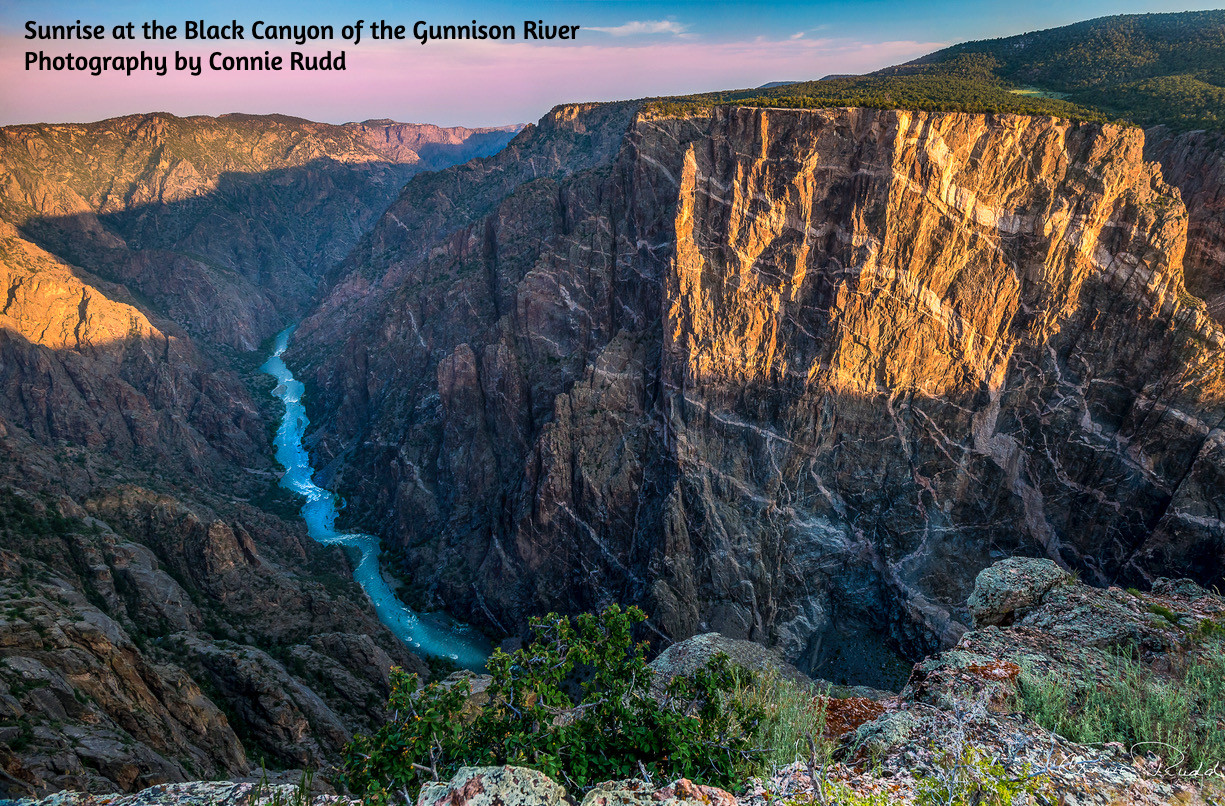
This is all what we call beautiful (recording it on our phones), but there is something else in these Gunnison canyons that goes beyond the pastoral scenic. You can get some of it in Connie Rudd’s sunrise image of the Black Canyon above. (Connie Rudd was superintendent of the Black Canyon National Park for a number of years.) The rock in the Black Canyon is not really black, but much of it is shadowed most of the time – not black so much as noir. The image shows the feature known as ‘The Painted Wall,’ due to its multicolored nature, but none of that is painted on; the river has exposed a cross-section of metamorphic rock that has been roiled, rolled, twisted, tilted, split and overturned, always under great pressure from earth layered on above and great heat from earth’s core hell. Rock that has had a hard life, not a comforting thought looking up at the walls from river level.
How did such a canyon system come to be? Gunnison Country geologist Tom Prather suggested that the Gunnison River, snowmelt from the already old Southern Rockies, had set its course looking as water does for the easiest routes through several hundred feet of fused volcanic ash from San Juan volcanoes to the south – on top of fused volcanic mud from the West Elk volcano to the north. And with its course already set in that stone, the forming river encountered the southern edge of a big blorp of metamorphic rock that was – well, just there. So rather than continuing to develop the open wide-V valley that most rivers are known for, the Gunnison River was captured by the hard rock with nothing to do but to cut an ever-deeper canyon that stayed steep and narrow with great hardrock walls in the Gunnison River’s Black Canyon and Gorge.
I am personally fascinated, in Rudd’s image, by how it shows the relative thickness of life as a layer contrasted with the geological layers. Look at the scrubby pinion-juniper and oak on the top of the Painted Wall. To call that layer of life on that mass of rock ‘skin-deep’ is almost an exaggeration. Our fossil-fueled efforts have expanded the layer of life to the seven miles or so above earth’s surface where we regularly fly, and the mile or so beneath the surface where we go to mine things we think we need, with nothing but microbial/incipient life above or below that. So life on earth occupies a layer 1/1,000th the diameter of the planet. If we remove fossil energy from the equation, the layer of earth and atmosphere occupied by life is probably measurable in thousands of feet rather than miles, less in total than a rounding error in the scale of the planet.
We’ve all heard the saying, ‘beauty is only skin-deep.’ But life is only skin-deep on the planet – ‘beauty’ is a term that works well in evaluations within that thin skin (as Connie Rudd’s image of the Painted Wall at sunrise is beautiful in its execution). But to be down in it, floating past rocks the size of small autos that came off those walls towering above – what’s there is some unarticulated and dynamic mystery beyond beauty. Maybe ‘awesome’ worked descriptively before that became a standard response to questions like ‘want to go for a beer?’ Maybe ‘Magnificent.’ ‘Stupendous.’ Or maybe just ‘brutal,’ if you’re floating along beneath it all; we don’t really get into its mystery until we’ve put it in terms in which we can feel something of the pain or ecstacy of what’s happened there.
Down in places like the Gorge that are beyond mere beauty and other ‘surface’ evaluations, I find my mind being stretched to the elastic limit over a concept like ‘nature.’ Or ‘god.’ The majority of us seem to be beyond a thoroughly churched ‘god’ (or panel of gods) as the creative force in the planet and its layer of life, but many of us seem to have just transferred to ‘nature’ that belief in some creative/destructive force larger than ourselves.
But it is not possible – for me, at any rate – to look up at these crumbling walls of tortured rock, some with trees struggling to grow in cracks in the rock until the roots split off the rock and tree and rock go in the river below with a wave that would smash a passing raft and its vacartioning passengers against the far wall – I can’t look at all of this and think of a loving ‘mother nature,’ a wisdom font of the sort we seem to want ‘nature’ to be, ultimately in charge of everything – that’s as hard as it is/was to look at ‘creation’ and imagine a ‘father god.’
Can we have creation without a designated creator – ‘god(s)’ or ‘nature’? All the ‘natural’ evidence I see points that way. In nature, life just happens, unfolds, evolves as it will or can: things just keep happening in what we call ‘nature,’ and when something happens, everything it happens to responds in some way – engages with it, absorbs or incorporates it, attacks it, tries to ignore it, sometimes succumbs to it, sometimes evicts it, and the whole incredible mishmash of life changing to adapt to things happening goes on. Sometimes what happens is something not happening, like a winter’s worth of snow not arriving, but it’s the same process: everything that this happens to responds in some way (some by also not happening)…. Life happens, and the living respond, and what happened (or didn’t) becomes part of life, in which things keep happening, on and on….
And to the extent to which old things happen in new places, to new groupings of living things with new responses and new outcomes, the process is creative, creation – sometimes creative destruction, but creation is not judgmental; creation just happens – as any mendicant poet or painter knows, trying to ‘look strange-eyed at the mindless world’ for the ‘dry sticks to turn to gold’ (thank you, Grendel).
That seems like the ‘nature of nature’ to me, and the nature of creation – and it has nothing to do with some set way that things are supposed to be. There’s no Garden of Eden/prelapsarian wilderness which we have destroyed or been ejected from; we still have all the indifferent wildness we can handle with the undomesticated Trumps, corporations and other weeds that grow out of the cracks of civilization’s pavement. American predatory capitalism is happening to the whole planet now, and everything on the planet, including its enshrouding atmosphere, is beginning to respond to that, seldom with appreciation.
Or so it seemed anyway, floating down the Gorge, in a protected wilderness park with nothing much to do but go with the flow and think about the life happening around me. One thing a water nerd like myself would of course think about, in thinking about the life happening around us, was the flow of the river that floated our raft. I knew the river was flowing at 300-350 cubic feet per second (cfs) through the Black Canyon and the Gorge; that flow was decreed as a year-round water right back in 2009 with priority to 1933 – along with an annual ‘spring flood’ flow for a short period usually in May, the volume depending on the depth of the mountain snowpack. Despite wilderness status for the Gorge and the ’natural’ appearance of everything there, the quantity of water flowing through is tightly controlled via releases from three dams upstream.
A week or two after our float, the Bureau of Reclamation began cutting the flow to 200 cfs in response to the ‘creative destruction’ of the winter of 2026 that was happening. This reduction is happening mostly to protect the viability of the reservoirs from whence the water issues, but the river’s response to it will be to make some of the rapids in the Gorge more interesting (less water, more rock), and it may shut down the fishing (and some of the fish) as the remaining water warms to the point of endangering aquatic life.
We do have to face the fact that many, maybe most of our vaunted achievements as a civilization have not made life in the long run – even the medium run – better for ourselves and a lot of the rest of the planet’s life in a very basic way. And it seems to me we would probably do better at it if we could get away from the idea that some ‘god as a parent’ or ‘mother nature’ is going to show us The Way. The Way is still evolving, happening day by day, happening by happening. It’s truly dieu et la nature parmi nous, ‘god and nature among us’; someday maybe we’ll evolve enough to see that realizing either god or nature (making them real) is up to us, if we can come to collaborative execution as effective as our imagination. And we may do better there if we stopped looking and listening for god or nature as an already written book, and did more stopping, looking and listening for our own likely impacts before bulling ahead the way we usually do in the name of god or nature. Like it or not, we are probably writing the book, with a lot of the Old Testament chaos of false starts and backslides.
A line from a movie whose name I’ve forgotten came to my mind down in the Gunnison Gorge, a movie that ends (as I recall) in a lifeboat with the boat captain encouraging his rowers, ‘Pull for the horizon, boys; it’s better than nothing.’ A message of hope, as I remember, which should never be confused with optimism.
Okay – next post I’ll get back to the larger river and its challenges. Meanwhile, I hope all of you get some time to just irresponsibly drift this summer, like me in the Gunnison Gorge, and think about how life happens, and maybe some better responses we might all try to learn, better together.
***
ANOTHER SHAMELESS ADVERTISEMENT
FOR MY POETRY BOOK
I am not optimistic
that things will get better
but still I hope
they will
hope
damned hope
hope damned
hope
the daisy game
is my game
petals to
the mettle
I can’t
not hope
An address by email to george@gard-sibley.org
will get payment information and a book
winging – okay, plodding its way to you.
Leave a Reply
Recent Posts
- Romancing the River – Moving toward Bankruptcy Management
 In the last post here, I argued that, water-wise, the Colorado River region is no longer in a ‘water crisis’ – a term implying a situation where some changes and adjustments need to be made ‘to get back to normal.’ No. We will never get back to the 20th century Colorado River ‘normal’ – the ... Read More
 - Romancing the River: Bankruptcy in the Slough of Despond
 You may remember my mention in early February of a research paper from scientists at the United Nation University Institute of Water, Environment and Health, titled Global Water Bankruptcy: Living Beyond our Hydrological Means in the Post-Crisis Era. The report begins: ‘Amid chronic groundwater depletion, water overallocation, land and soil degradation, deforestation, and pollution, all ... Read More
 - Romancing the River: Let us gather by the river….
 Every so often it just seems like a good idea to drop out of the wrangling over the future of water in the arid west and – just go down to the river itself. A good friend abetted this by taking me along on a float down the lower Gorge of the Gunnison River. My ... Read More
 - Romancing the River – Another Elephant to Ignore
 Last post here, I suggested that at least some of the ongoing failure of the seven Colorado River states to reach agreement on a river management plan for even the next several years, let alone new century, stems from some ‘elephants in the river.’ You know – the big things that nobody wants to look ... Read More
Hey George, Enjoyed this ramble very much. Perhaps we need a fresh word or words to do the work of nature /god/goddess?
Onward,
Vince
C’mon, George.
Send it my way.
Pat Thurmond
3705 Woods Edge Rd
Columbia, Mo 65203
Done. Hope you’re enjoying it!
Thank you, dear George, for this ride down the canyon with you. Your musings always ring true. I want a copy of that poetry book. Send info. I send love. Barbara
Poor hapless JD Vance has no concept of language or the title of the book he probably did not write and most certainly did not live. You have provided and elegy to the Black Canyon and its river. Thank you my friend
Dear George,
I am so enjoying your poetry and love the title. We’ve all got plenty of that, but few of us can alchemize it into art:)
Was very moved to see your tribute to Cindy and her singers. I will be returning to your book again and again!
Thank you,
Terrie
Poetry does not usually appeal to me, so I was surprised how much I enjoyed George’s “Storm in My Head.” Well worth the $16.