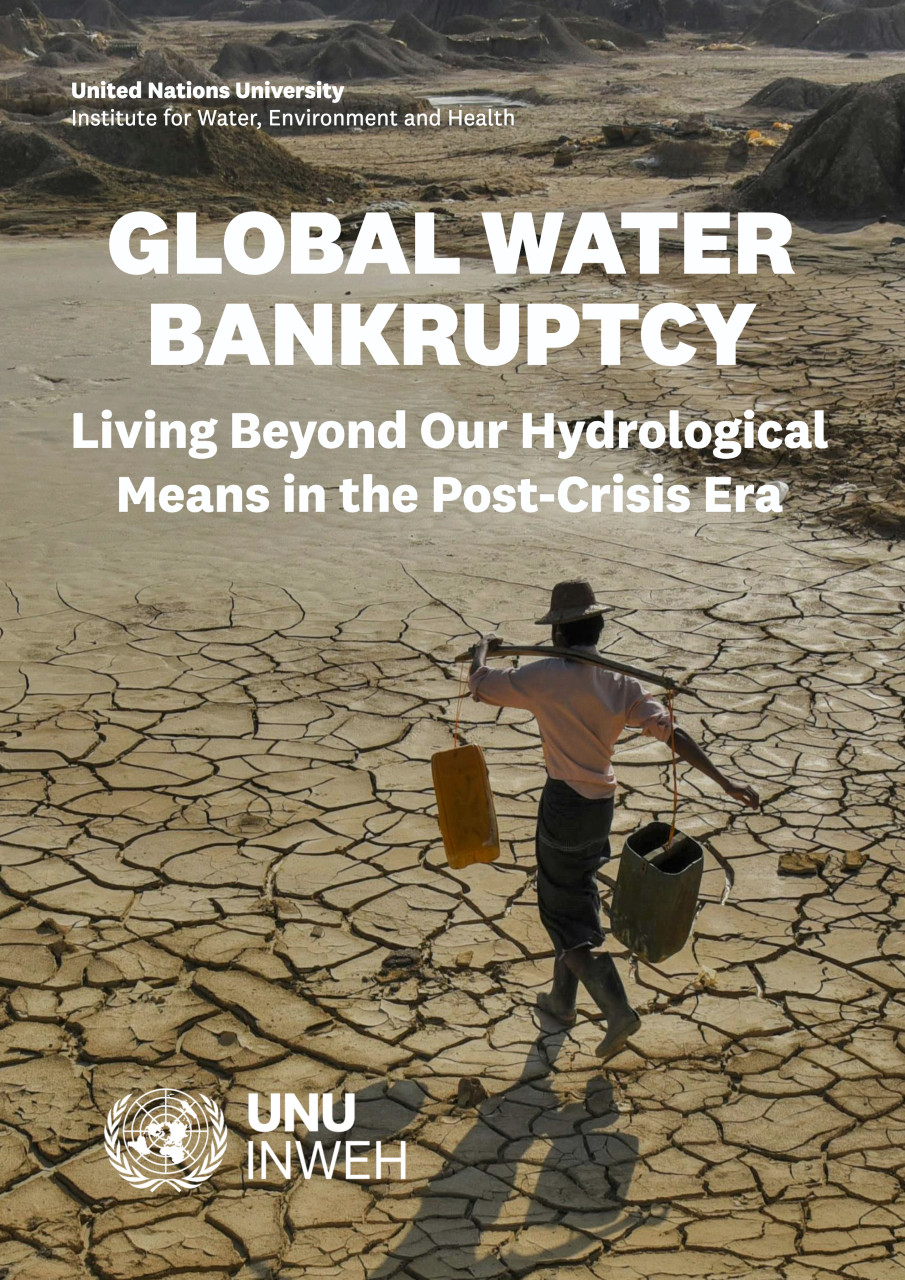
You may remember my mention in early February of a research paper from scientists at the United Nation University Institute of Water, Environment and Health, titled Global Water Bankruptcy: Living Beyond our Hydrological Means in the Post-Crisis Era. The report begins:
‘Amid chronic groundwater depletion, water overallocation, land and soil degradation, deforestation, and pollution, all compounded by global heating, a UN report today declared the dawn of an era of global water bankruptcy, inviting world leaders to facilitate honest, science-based adaptation to a new reality.’
Our Colorado River made their list of exemplary global ‘hot spots’ for bankruptcy, with the observation that ‘the Colorado River and its reservoirs have become symbols of over-promised water.’
You’ve seen the word ‘crisis’ used frequently this year in the countless morbid articles about the Colorado River. But the UNU Institute director Kaveh Madani argued that we are now ‘post-crisis’: the term ‘crisis’ implies a deviation from the normal, a disruption to be dealt with in order to get back to normal, but there is now, Madani says, no going back to what passed for ‘normal’ in the last century.
The study indicates that we have drained too many aquifers, resulting in subsidence that destroys the aquifers for the rest of the geological age; we have lost high-storage wetlands to gullying and lowered water tables; we have spread too much surface water out to dry under an atmosphere heating up incrementally with every additional gallon of fossil fuel we burn; desertification spreads in our wake; et cetera, et cetera. As a result:
The report makes the case for a fundamental shift in the global water agenda—from repeatedly reacting to emergencies to “bankruptcy management.” That means confronting overshoot with transparent water accounting, enforceable limits, and protection of the water-related natural capital that produces and stores water—aquifers, wetlands, soils, rivers, and glaciers—while ensuring transitions are explicitly equity-oriented and protect vulnerable communities and livelihoods.
There is in this research paper the kind of lovely naivete that one finds in most of the analyses of Big Issues today (climate change, systemic racism, corporate personhood versus people, etc.); there is an underlying conviction that when the facts are all laid out, we will rationally accept that, yes, we are indeed in a bankrupt situation. And so we will all sit down together, like rational beings would, and work out ways to resolve the ‘reality deficit’ between what has been promised and what can be delivered.
This ignores the fact that, when we are first confronted with evidence of something so big in its threat to our way of life, that its correction might require creating a whole new way of life, our first response is to say, ‘this can’t be so.’ There has to be a mistake. And a long winding road leads on, into and through a morass of denial, anger, blames cast, responsibilities denied, hopeful negotiations and underlying despair – the whole medieval pilgrim’s Slough of Despond that must be negotiated before we might actually sit down together and work out some way of resolving the ‘reality deficit.’
There is, however, a kind of honesty in coming around to realizing – and acknowledging – that a system might be bankrupt. Bankruptcy is not necessarily the end song of what has become bankrupt, although it can be (Chapter 7 bankruptcy). It can instead be a time of operational or financial reorganization, aa time for acknowledging circumstances, conditions and misconceptions not originally taken into account that, accounted for, might enable a measure of eventual recovery and even success.
The seven Colorado River Basin states, still stuck in the zomboid Colorado River Compact, are not there yet, but the Bureau of Reclamation might be getting there. On the viable assumption that the seven states will not come up with a last-minute plan before the end of September and expiration of the Interim and Interim Interim Guidelines, they are preparing to institute a temporary plan that will maintain functionality in the river storage and delivery system, with (they hope) no embarrassing ‘dead pool’ episodes – which basically means getting and keeping as much water as possible in the two big reservoirs, Mead and Powell, and that can only happen at considerable cost to users below the big reservoirs.
The Bureau plan will not be carved in stone for forever like the Colorado River Compact; the Bureau will basically be planning operations for two-year periods, through the coming decade; every two years, the parties of interest will reconvene to review and revise the operating plan as circumstances require. This ‘adaptive’ approach makes sense in a bankruptcy situation in which the future is mostly unknown.
The plan really has no surprises for anyone who remembers the 2022 bolt of reality that caused Bureau Commissioner Camille Touton to tell the water leaders in the seven states to immediately plan to voluntarily cut 2-4 million acre-feet (maf) of water use – basically a quarter of river use at that time – or the Interior Department would do it for them. That – in the centennial year of the Compact – is probably a good marker for the Bureau’s acknowledgement that we were beyond crisis, and slipping into bankruptcy.
That 2022 siren call was met by the Lower Basin states agreeing to finally take the Lower Basin system losses (evaporation, etc.) and their half of the Mexican obligation out of their river-use shares rather than out of Mead storage until the 2027 water year – provided they would be paid to do so. The absence of ‘surplus flows’ to take care of those losses – ~1.25 maf – from the coming online of the Central Arizona Project was a principal source of the draining of the big reservoirs, the so-called ‘structural deficit,’ 30 maf of storage gifted to the Lower Basin.
(A side note on this: The Upper Basin states, since a 1970 Law-of-the-River agreement, have been regularly sending downstream their 750,000 acre-feet for the Mexican obligation and absorbing as part of their whatever’s-left-over share of the river the ~400,000 acre-feet of Upper Basin system losses. The four states have never asked for or been paid for doing that.)
But that 1.25 maf of voluntary shortages was only a large fraction of the 2-4 maf of cuts the Bureau said needed to happen. So the Bureau’s original 2027-28 plan announcement in late July included cuts of up to 40 percent for the states below Mead Reservoir (Arizona, California and Nevada) – roughly equivalent to the 2022 request for 2-4 maf in cuts. The three downriver states countered that with an offer to permanently do the same 1.25 maf cut (with payment) for 2027-28 they were doing for 2025-26, with intimations of lawsuits if the Bureau pushed too far beyond that.
Arizona has led the countercharge from the states below Mead Reservoir – being the state with the most to lose, since the junior status of the Central Arizona Project means it would be practically shut down by 40 percent cuts in usage.
A letter to the Interior Department from Tom Buschatzky, Arizona’s Director of Water Resources, castigated the Bureau plan for making no mention of the Colorado River Compact and the Law of the River (LOTR). The letter insisted that Article III(c) and (d) of the Compact be executed to the letter as stated in the LOTR 1970 agreement: that a minimum of 8.23 maf be released from Powell Reservoir every year – the Compact commitment of 7.5 maf per year on average passing Lee Ferry, plus the Upper Basin’s share of the Mexican obligation (750,000 af/year).
In their August 21 announcement of the more detailed plan for 2027-28, the Bureau backed down from the 40 percent number, and now wants a 20 percent reduction in use for the two years – more in line with the Lower Basin’s willingness to continue taking care of its own system losses and Mexican share, but requiring some additional cuts – and avoided discussion of the Compact issue raised. It will, however, probably be pushing for more cuts in the 2028 discussions for the 2029-30 plan renewal; the Bureau still feels that it needs at least 3 maf in permanent cuts to begin any hope of turning the current near-bankruptcy around, and bringing demand in line with at least current supply.
The Bureau would also like the seven states to be reviewing, revising and executing the two-year plans consensually by 2036, rather than imposing it on them. But Arizona, according to the Buschatzky letter, wants a ‘longer, more comprehensive’ plan from the states, consistent with the LOTR, and ‘does not accept a framework that gives the federal government the discretion to select from a wide range of alternatives—including catastrophic cuts to the Lower Basin—every two years for the next decade.’
‘Bankruptcy management’ would seem to argue that the Colorado River Compact should be on the table along with everything else – including the nonexistence of the 18 maf river for which the Compact was written. A detailed analysis of the current situation by the ‘River Elders’ – the Kuhn-Schmidt-Castle group – suggested that ‘Basin water users must focus on solutions to the fundamental, wet-water math problem, rather than legal arguments over paper water.’
Nonetheless, Buschatzke’s letter states that ‘Arizona reserves the right to seek the resolution of its Compact rights in an appropriate judicial forum.’ The states are not yet willing to acknowledge the bankruptcy of the Compact – a Humpty-Dumpty that not all the patches and bandaids of the Law of the River can put back together for an ever-shrinking 21st century Colorado River.
That, more or less, is where the river system’s future sits as of August 21. There will – thanks to the Bureau – be a plan for moving carefully into the future, a two-year step at time. A big question is how hard the Bureau will begin to push for the 3-4 maf in permanent cuts by users necessary to stop the march into real dead-pool bankruptcy of the system – leading to another big question: whether the Compact nostalgitarians will push the system into dead-pool bankruptcy by suing the Bureau/Interior Department over paper water, tying things up in court for another several years.
Ah, the lovely Slough of Despond. There with Henry: ‘All day the sun has shone on the surface of some savage swamp, where the single spruce stands hung with usnea lichens, and small hawks circulate above, and the chickadee lisps among the evergreens, and the partridge and rabbit skulk beneath; but now a more dismal and fitting day dawns, and a different race of creatures awakes to express the meaning of Nature there….’ Bankruptcy, the Apocalypse – only the end for those who fail to see that something else is always struggling for a chance to be born; don’t put a period where God (or Nature) would put a comma (Gracie Allen). As Henry also observed, ‘The light which puts out our eyes is darkness to us. Only that day dawns to which we are awake….’
Next post, I want to go back to the ‘desert river’ concept to think a little outside the (Compact) box.
Leave a Reply
Recent Posts
- Romancing the River: The Real ‘Two Basins’ of a Desert River
 This will be my last post before what might be our last election – if our would-be tyrant doesn’t succeed in stopping it entirely. I encourage my handful of readers to vote early, and then be prepared to participate in public opposition – make a big noise – to the chaos our PINO will surely ... Read More
 - Romancing the River – Moving toward Bankruptcy Management
 In the last post here, I argued that, water-wise, the Colorado River region is no longer in a ‘water crisis’ – a term implying a situation where some changes and adjustments need to be made ‘to get back to normal.’ No. We will never get back to the 20th century Colorado River ‘normal’ – the ... Read More
 - Romancing the River: Bankruptcy in the Slough of Despond
 You may remember my mention in early February of a research paper from scientists at the United Nation University Institute of Water, Environment and Health, titled Global Water Bankruptcy: Living Beyond our Hydrological Means in the Post-Crisis Era. The report begins: ‘Amid chronic groundwater depletion, water overallocation, land and soil degradation, deforestation, and pollution, all ... Read More
 - Romancing the River: Let us gather by the river….
 Every so often it just seems like a good idea to drop out of the wrangling over the future of water in the arid west and – just go down to the river itself. A good friend abetted this by taking me along on a float down the lower Gorge of the Gunnison River. My ... Read More
“Say goodnight, Gracie.”
That sounds more like a period where nature just does commas….
How ’bout we get all the states to agree to just keep kicking the can down the road? Talk about a popular solution!
Meanwhile, keep waterin’ them Phoenix golf courses.
Part of the can-kicking problem is there’s no known road today to kick the can down….
I recall a discussion I had with Rollie Fisher, maybe as long as 40 years ago that reflected much of this thinking. It is too bad that Arizona and California has long grown on borrowed water and ironic that Nevada, a better steward is suffering the most. The desert will reclaim its own, of that I am sure.
Yes. Growing on borrowed water was certainly a mistake in the desert. Underneath all the manifesting troubles seems to be a failure to take desert development seriously – to take the desert seriously. ‘It’s the limited water, stupid!’