This will be my last post before what might be our last election – if our would-be tyrant doesn’t succeed in stopping it entirely. I encourage my handful of readers to vote early, and then be prepared to participate in public opposition – make a big noise – to the chaos our PINO will surely try to cause if he doesn’t like the outcomes.
The mainstream media (being mostly owned by billionaires) continue to try to portray this election as just another horse-race between ‘Democrats and Republicans.’ It is not that. This election may be out last chance to salvage what the Trumpsters haven’t yet undermined of our 250-year effort to work out a functional governance by, for and of the people – a representational governance, a form of democracy. At present nearly all of our supposed representatives in Congress who call themselves ‘Republicans’ and many of those who call themselves ‘Democrats’ are clearly ‘owned’ by those with the money to fund their campaigns – the oligarchs and kleptocrats who want to replace that 250-year effort with an authoritarian governance that they believe will be more ‘efficient’ in accommodating them.
The only hope for keeping our 250-year experiment in self-governance going is to replace the sellouts with representation in the mold of Bernie Sanders, Elizabeth Warren, Alexandria Octavio-Cortez and others who truly try to speak and act on behalf of us, rather than of those whom we have all helped make morbidly wealthy. And we will only be successful if it is a decisive victory for the people; one or two percent victories will be challenged and kept in chaos until – well, forever: nearly a third of the voting electorate still believe that Trump was cheated out of a 2020 election victory because Trump says so. He is determined to keep this election from being a conclusive victory against him because he knows that the only way to stay out of prison is to stay in the presidency with a compliant Congress.
So vote as if the future depended on it – because it does. We do not want to live in an oligarchic kleptocracy run by a semi-senile narcissist with his gang of thieves pillaging the people to pay for technologies of mass control, with his army of brownshirt ICE agents running rampant in our streets. If we don’t come out of the election with a Congress at least partially in control of representatives of the people (not just ‘Democrats’ – think of Fetterman), then it is all over.
Meanwhile, back on the banks of the bankrupt Colorado River system. Remembering first that the river system is not the river itself. The river itself is what it has always been: flows of water running through river-carved valleys and canyons because the surrounding land has not put those flows to use in service to living things. The flows move on to other valleys where sometimes they are put to use by plants, forests, wildlife including humans, and sometimes not, then flowing on to other valleys until they all eventually join up and get to sea level, reentering the seas from which they came. Those flows ebb and flow themselves, annually and year-to-year, at the whims of the global climate – which at this point has the human thumb on the scales pushing toward the hotter drier side.
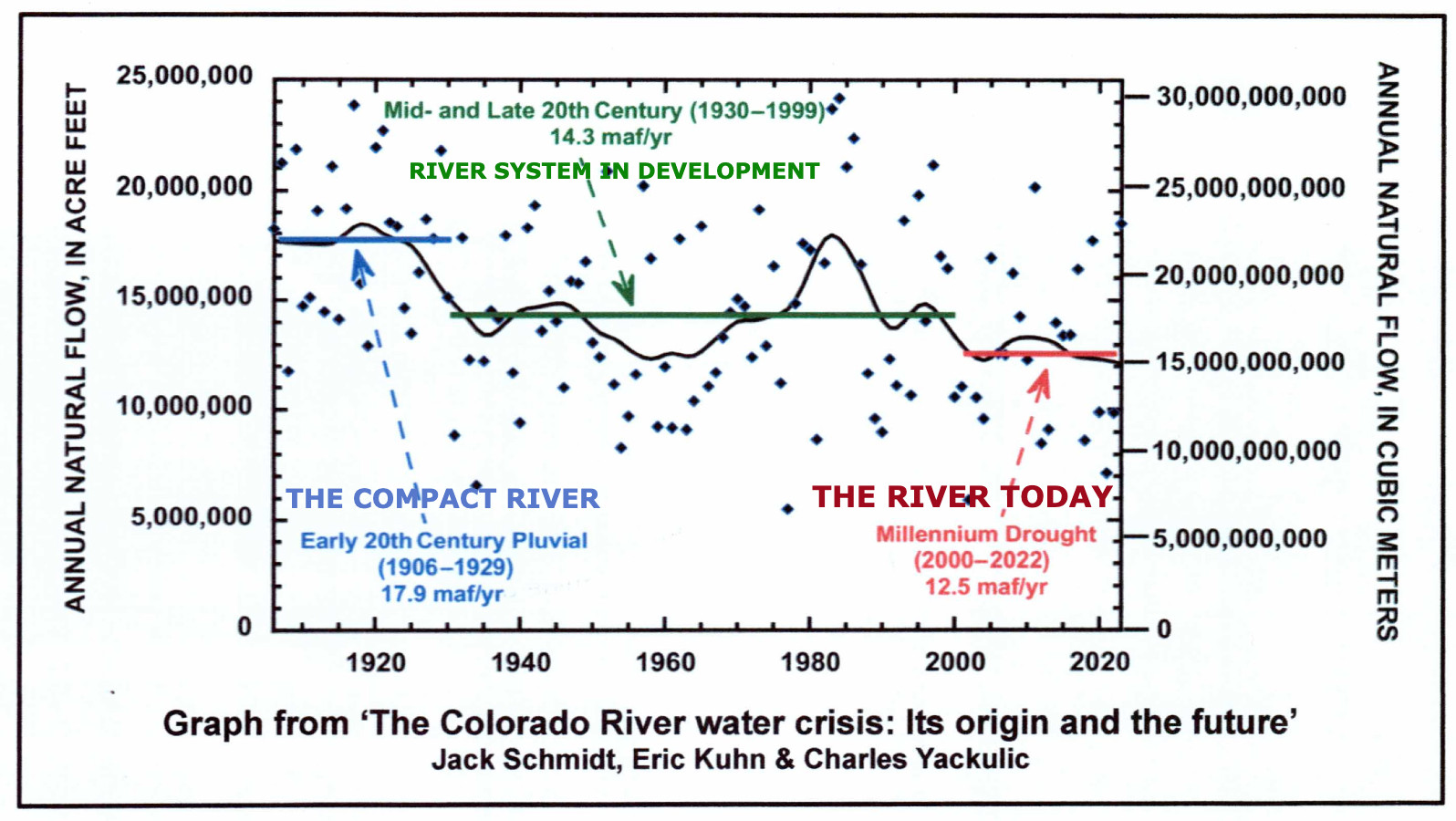
That’s the river; the river system is the structures for storage and distribution we have imposed over the river to even out the natural flows, annually and year-to-year, in service to human life. But the system was designed for a river half again larger than the river we’ve had since the turn of the century; it is beyond rational denial that it was overbuilt for the river we now have (see the graph above), although many continue to deny it for reasons including plain desperation.
The problem of overbuilding and its consequences could be illustrated by imagining operating your home ‘water infrastructure’ with a municipal system that can only deliver a gallon or two of water per hour to your home. It is possible to live with that much water; a lot of what we call the Third World uses less water than that per dwelling every day. My family and I lived for four winters as backcountry caretakers, and made do with five gallons a day hauled from a nearby spring (another five on weekly wash day). But at severely reduced levels, most of our current home water infrastructure – flush toilets, big tubs with showers, dishwashers – become shut-down obstacles at a gallon an hour if we try to use them as usual.
Reservoirs capable of storing 20-30 million acre-feet of water (~10 trillion gallons) ‘fit’ a river running 15-20 million acre-feet (maf) a year, but for a river running half to two-thirds of that, they become something like the flush toilet or shower when the house system runs a gallon an hour, a potential obstacle to take into account – especially if some of the users are behaving as though the river still ran a compacted 16.5 maf.
So how do we handle the bankruptcy – once we stop digging ourselves in deeper (if we actually do)? I have ragged on the insufficiencies of the Colorado River Compact enough so that the reader might assume I would start by suggesting we at least alter or amend it to reflect current reality, if not get rid of it entirely as is and try to do a more ‘fitting’ compact.
That suggestion will come in time, but first I think we need to define the current reality (which bears no resemblance to ‘Compact reality’). The first step is to acknowledge the nature of a desert river, then try to adapt our basic thinking and planning to that.
All rivers are water that the surrounding land and its diverse inhabitants have not managed to put to ‘beneficial use’ for the living ecologies the river runs through. That ‘left-over’ water flows on from its home watershed to larger multiple watersheds where it either gets put to use or doesn’t, and if not, it flows on even larger basins, et cetera. Hydrologists describe streams as ‘gaining’ or ‘losing’: a stream that adds surface and groundwater from a watershed with a high water table is a ‘gaining stream’; a stream that gives up some of it water to a watershed with a lower water table is a ‘losing stream’ (although I think it ought to be called a ‘giving stream’).
Many humid-region rivers continue to collect more water from precipitation that falls on them and their surrounding land, from its headwaters all the way to its ocean estuary. A desert river, on the other hand, gets nearly all the water it will ever have from its headwaters region, with mountains or plateaus high enough to force rising air to cool and release any water vapor it carries as precipitation – mostly winter snow in the case of the Colorado River. Most of the Colorado River headwaters are in the Southern Rockies, but the Wind River Mountains in the Central Rockies generate some of the Green River tributaries, the Colorado Plateau and New Mexico highlands generate the Gila River; smaller basin-and-range mountains the Virgin River, et cetera. But the precipitation that falls on those high places generates 85-90 percent of the water that will make its way into the Colorado River; once it leaves its headwaters and flows into its desert regions, it will gain very little new precipitation.
This transition from gaining streams to losing (giving) streams happens fairly quickly in the Colorado River’s natural basin. The majority of its water comes from highlands above ~8,000 feet elevation – about ten percent of the entire basin. In the Upper Gunnison River watersheds where I live, major Gunnison River tributaries leave the Crested Butte area at 9,000 feet elevation where the average annual precipitation is 23 inches (up to 40+ inches on upvalley); a mere 35 miles down the valley in Blue Mesa Reservoir, at 7,500 feet elevation, the average precipitation has dropped to 10-11 inches. In that short distance, the Gunnison River is already in the high deserts of the Colorado Plateau, and most of the valley below Crested Butte is under irrigation – the river already ‘giving.’. The Gunnison River gets larger as it flows west and north to its ‘grand junction’ with the Colorado River, but that is due to picking up other tributaries; very little precipitation water gets added – even in the summer monsoons, according to a hydrologist working in the Upper Gunnison.
Prior to the Euro-American presence in the basin, the Colorado River ran in extremes: a flood of water while the snowpack was melting in the high headwaters, then a comparative trickle in the late summer and fall after the snowmelt ends. The flood months nurtured riparian life throughout its course, from a narrow strip in some places to broad wetlands, meadows and cottonwood ‘oases’ in other desert places, culminating in a lush labyrinthian delta on a dyke it had built across the Gulf of California with debris from creating the Grand Canyon through the Colorado Plateau. Whatever was left in the stream after it made its way through the delta went back into the ocean from which it had come – and one imagines there were many drier years when there was not enough water left below the delta to go into the ocean after the early summer flood finished.
We tend to make a big deal about the Colorado River no longer flowing to the ocean now due to our heavy use, but there are many desert rivers around the world that don’t flow into the oceans; some forty streams flow into the Great Basin from surrounding mountains and plateaus – some of them respectable rivers like the Truckee, through Reno – and they all gradually disappear there, after nurturing riparian life (including some ranches and towns), enduring evapotranspiration, and sinking into aquifers. President Theodore Roosevelt, often called the father of American conservation, considered freshwater going unused into the ocean to be a ‘waste.’
But understanding the nature of the desert river, and how it is different from a humid-region river like the Mississippi, offers some clues about an intelligent river system for storing and distributing the river. The vast majority of the users of the river’s water, especially the modern human users, are in the desert lands below the headwaters region – the ‘losing’ (‘giving’) portion of the river: in the higher ‘cold deserts’ above the canyon region, and the subtropical ‘hot deserts’ below the canyons.
There are also water users in the headwaters region. Largest by far are the forests that ring most of the mountains, along with other plant and animal life inhabiting those mountain-forest regions. There are also humans in the headwaters, mostly in or near towns supporting mining or outdoor recreation, but what makes the most sense is to consider the human users as outliers of the ‘losing’ basin below the headwaters – which they are, literally, producing little of what they need to live there but importing moat of it from or through the desert economy. The forests, on the other hand – as we will see – are intimately involved in the river’s water production processes, in both positive and negative ways.
These two distinctly different parts of the river suggest a more natural division of the river into two ‘basins’ than the political division under the Compact: the ‘gaining river’ and the ‘losing/giving river,’ each to be managed toward a specific goal: for the gaining river, how to optimize the quantity of water flowing out of the headwaters; and for the losing/giving river, how to optimize the uses and minimize unnecessary losses.
This deliberately breaks up the current ‘two-basin division’ – a ‘temporary equitable division’ adopted in 1922 because the compact commissioners did not know enough about their the river or their own state futures to do the eight-way division (including Mexico) they had set out to do. The two-basin division was most basically an expedient way of persuading Congress that they were together in their search for an equitable division that would only become possible when there was ‘a greater fund of information’ that would enable those following them to do a proper division of the use of the river’s waters, but meanwhile – let’s build the big dam.
Dividing the river into its ‘water production’ basin and its ‘water consumption’ basin would have the potential benefit of starting again with nearly all of the users in a single ‘consumption’ basin, while giving them all joint responsibility for taking care of the ‘water production’ basin. It’s a potential start on at least perceiving the river as a single shared responsibility, as opposed to the current perception of each state in it for its own needs and yielding as little as possible to the other states.
That’s where we’ll start next time – with the big question for the losing/giving river, the desert part of the desert river: how to get beyond Compact fantasies, and divide the use of the diminishing river we actually have among the vast multitudes of users (see the graph at the beginning). That’s a point at which I think it would be smart to abandon the hydrologic term ‘losing’ for a more political term – not a ‘losing river’ but a ‘giving river’ -which is what it is once it leaves the headwaters. And the challenge of ‘dividing the gifts’ of the giving river at least starts with a more positive feel than ‘sharing out the losses’ from a losing river….
Meanwhile – vote! As if the future depended on it because it does.
Recent Posts
- Romancing the River: The Real ‘Two Basins’ of a Desert River
 This will be my last post before what might be our last election – if our would-be tyrant doesn’t succeed in stopping it entirely. I encourage my handful of readers to vote early, and then be prepared to participate in public opposition – make a big noise – to the chaos our PINO will surely ... Read More
 - Romancing the River – Moving toward Bankruptcy Management
 In the last post here, I argued that, water-wise, the Colorado River region is no longer in a ‘water crisis’ – a term implying a situation where some changes and adjustments need to be made ‘to get back to normal.’ No. We will never get back to the 20th century Colorado River ‘normal’ – the ... Read More
 - Romancing the River: Bankruptcy in the Slough of Despond
 You may remember my mention in early February of a research paper from scientists at the United Nation University Institute of Water, Environment and Health, titled Global Water Bankruptcy: Living Beyond our Hydrological Means in the Post-Crisis Era. The report begins: ‘Amid chronic groundwater depletion, water overallocation, land and soil degradation, deforestation, and pollution, all ... Read More
 - Romancing the River: Let us gather by the river….
 Every so often it just seems like a good idea to drop out of the wrangling over the future of water in the arid west and – just go down to the river itself. A good friend abetted this by taking me along on a float down the lower Gorge of the Gunnison River. My ... Read More