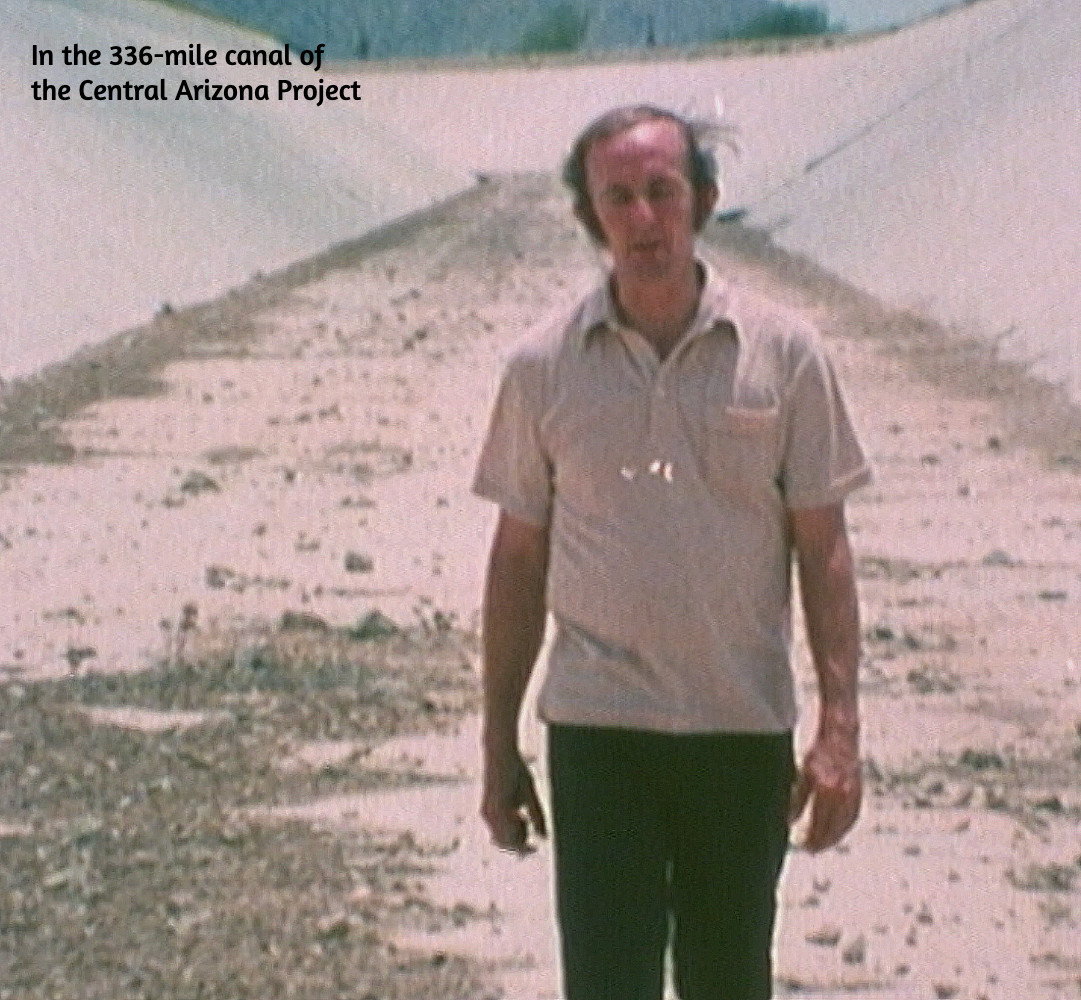
The image above is yours truly, in an unauthorized 1981 tour of the canal for the Central Arizona Project (CAP) – no one was around to ask permission, so I had to climb over a fence to get into it. I was working with film auteur and friend, Len Aitken from Boulder, on a film about the Colorado River based on an article I had written for Harper’s in 1977.
Throughout the film Len used narrative backgrounds, like this one, that showed the massive magnitude of these efforts to, as it were, ‘make the Colorado River vision concrete.’ This 3,000 cubic-feet-per-second canal runs 250-some miles, from water backed up behind Parker Dam on the Colorado River (downstream from Hoover Dam) through empty desert to the Phoenix metropolitan area, and then, in smaller size, another hundred miles to Tucson.
With leaves and desert dirt blown in, it looks a little desolate; it was still under construction when we shot the film in 1981, and didn’t start to carry water until 1985; the CAP was declared complete in 1993. But today, Arizonans fear that the desolated look here might be the look of the future…. And therein lie some stories – ironic for sure, but also tragic, if your definition of tragedy is ‘knowledge gained too late to prevent the unfolding of misfortune that could have been avoided had the knowledge been gained before acting.’ Climate change. American political shifts. And the ever-unfolding tragedy of our overwhelming success as a swarming species.
Last post I said we would begin exploring how the waters of a desert river might be more equitably distributed among users. I will get to that eventually. But right now current events along the Colorado River are unfolding and being reported with no sense of the currents flowing into and through them…. Some backgrounding, the rest of the story, is needed – if only for a morbid laugh or two.
Underlying these stories is the mythology of the desert conquered, a mythology embraced nationally: that technology, science and rationality would overcome and correct the irregularities and shortfalls of nature. This mythology had begun to show cracks by the time that big ditch was completed; the Central Arizona Project was the mythology’s last hurrah in the Colorado River Basin.
When I last wrote here, the Bureau of Reclamation had just rolled out a ten-year management plan to try to save the Colorado River system – mainly to prevent the two big storage reservoirs, Mead and Powell, from dropping to the dead-pool stage when water cannot be moved past the big dams. In order to be able to continue releasing water from the storage dams, the Bureau finds it necessary to reduce the amount of water they’ve been releasing this century.
Accordingly, the Bureau announced in their ten-year plan – an adaptive plan to be revised as needed every two years – that 1.2 million acre-feet of cuts must be made in the first two-year segment, the 2027 and 2028 water years, all of it from the three states below Hoover Dam. And given the dour reality that the river’s flow will continue diminishing as the ambient temperatures rise, the Bureau’s ten-year goal is a total reduction among all users of at least three million acre-feet of consumptive use by 2035, to build up some semblance of carry-over storage in the system.
Nevada then had filed a lawsuit against the Department of Interior/Bureau of Reclamation over the cuts in water delivery proposed. And since then, both the State of Arizona and the Central Arizona Project Board have ‘intervened’ (joined) in the lawsuit.
The lawsuit claims that the Bureau is relying on the three Lower Basin states to carry the entire burden of the consequences of an ongoing quarter-century drought. The plaintiffs want the Bureau to impose cuts on the four Upper Basin states too, or at the very least to adhere to the ‘Law of the River’ built on the 1922 Colorado River Compact, requiring the Upper Basin states to – well, to continue doing what they have been doing for a century: making sure enough water gets past the Lee Ferry division point to meet the Lower Basin’s Compact share and the Mexican treaty allotment.
Irony begins with the State of Arizona asking the Bureau to adhere to the letter of the Colorado River Compact; Arizona had refused to ratify the Compact in 1922 – probably understandably. The original Compact objective had been to insure California’s rapid development would leave enough water in the river for the other six basin states; the Compact they came up with protected half of the river’s water for the four Upper Basin states, but left Arizona and Nevada, as it were, ‘in the cage with the 800-pound Bear State.’
In 1934, when the Bureau of Reclamation began construction of Parker Dam, below Hoover Dam (also still in construction), Arizona went on the offensive with California. The purpose of Parker Dam was to back up water for California’s pumping station for its massive 250-mile Colorado River Aqueduct to Los Angeles and San Diego. So Arizona’s governor sent the National Guard out to stop construction. This quickly devolved into a Keystone Cops comedy. A boat to confront the workers with an order to desist started to sink, and the construction workers rescued the Guardsmen and redeposited them on the Arizona bank, then went back to work and the National Guardsmen slunk back home.
Arizona finally signed the Compact in 1944, to get status to sue California over Compact issues – a semi-successful suit in which the Supreme Court, after ten years of analysis by ‘water masters,’ granted Arizona full use of the Gila River without charging its million-plus acre-feet against Arizona’s 2.8 million acre-foot ‘mainstem’ Compact allotment. But the court also mandated the allotting of water to several of the 22 First People tribes in Arizona and ordered negotiations to commence for providing water for other tribes – a responsibility bypassed in the original Compact.
But Arizona’s main problem with California’s Colorado Aqueduct was probably mostly their desire for an aqueduct like that for central Arizona – envy may be the largest root of irrational antagony.
‘Central Arizona’ is a region of relatively mellow desert river valleys – the Verde flowing in from the north off the Colorado Plateau, the Salt flowing out of canyons off the Mogollon Rim, and the Gila flowing up from the south off the Rim. The three desert rivers accumulate around a million acre-feet of upland water in a good year, which originally flowed off across the deserts as the Gila River, to a confluence with the Colorado River at Yuma. But by World War II, all three tributaries were so fully used in Central Arizona that water would only flow to Yuma in a big water year.
When Carl Hayden was elected to the Senate in 1926, after a decade as a central Arizona Representative, he had epitomized the mythology and the vision of a huge water project to bring water from the Colorado River to the upper Gila valleys. In the period of growth after World War II, he made it his opus magnum, with the people of Arizona returning him to office for seven terms until finally in 1968, after numerous defeats, the Colorado River Basin Project Act was passed, with the CAP its main focus. Carl Hayden, 90 years old, could finally resign at the end of his seventh term.
Compromises had been made to the simple purity of his vision, however. In order to get Arizona’s old nemesis California reluctantly on board for the vote, the bill had to specify that the CAP’s water right would be junior to other existing water rights in the Basin – thus running roughshod over the original Compact commission’s desire to allot to each state water to develop on its own schedule, independent of other states’ appropriative seniority.
By the 1960s, the surface water in the valleys was exhausted, and farmers and developers both had been pumping groundwater to the extent that emptied aquifers were beginning to collapse, causing surface subsidence. So the state was ordered by Interior to come up with a groundwater management plan before construction would start on the CAP. The state created a Department of Water Resources, and in 1980 adopted a Groundwater Management Plan with ‘Active Management Areas’ in the parts to be served by the CAP (basically the Phoenix-Tucson corridor); those areas were to be brought into ‘safe yield’ balance where withdrawals from the ground would be matched by CAP water plus existing surface supplies by 2025. Unfortunately, so many existing users were ‘grandfathered’ and exempted from restrictions that it was impossible to meet the 2025 goal of ‘safe yield’ in those AMAs by their target 2025. A quarter century of drought and the onset of climate change have not helped.
They also did something that could be regarded as wasteful, if not just stupid. The CAP base allotment from the Colorado River was just under a million acre-feet, but there was surplus water in the river system that was not yet being used by the Upper Basin states – and California had already, back in the 1930s, built its aqueduct to carry twice as much as its 500,000 acre-feet allotment, ‘borrowing’ some of that surplus until it was needed by others. And if California could do that, why couldn’t Arizona? And the Bureau, avatar of the desert mythology and blessed with a bad head for numbers, went along with it.
So the ditch I’m standing in was built to carry half again more water than its legal allotment. They advertised the proposed project as carrying a 50-year average of 1.2 maf. But that is what we night call ‘mathology’ – manipulating numbers to better serve a mythology. That deceptive ‘average’ began with projected deliveries of 1.55 maf in 1985, gradually decreasing to deliveries of 0.984 maf by 2035. So one of the fastest growing areas in the nation would have a declining water supply to grow on, and a canal eventually only 60 percent full – unless they could find some more water. Maybe from the Columbia River! But Oregon Senator Jackson cut that idea off, inserting in the CR Basin Project Act a ban on even discussing that for 25 years. Nonetheless, ideas of bringing in water from some other mythic river with a ‘surplus’ still float around.
A final Arizona short story from the 1970s that foretold the future of the desert mythology. In 1977 – a complete newbie in Colorado River matters working on an article for Harper’s about the river – I did a cold call at the office of Wes Steiner, Arizona’s head water engineer then. I was told that he wasn’t in; he was down at (some auditorium) at an open Water Commission work session about the proposed distribution of municipal CAP water when it was actually built.
I went down to that meeting, and basically watched the death throes of the desert conquest mythology. The Commission had 500,000 uncommitted acre-feet to meet requests for over two million requested for approved or pending developments. The way it resolved the problem was by giving everyone something – allotments ranging from 3 percent to 100 percent of their requests, with the average around 25 to 30 percent. The engineers were candid in saying that most of the developments would probably outgrow their issue of CAP water, and rather quickly.
As recently as 2021, even though there was no more ‘surplus’ water in the Colorado River Basin, the CAP deliveries were still in the 1.3-1.4 maf range; the Bureau, faithful to the mythology, was allowing its diminishing Mead storage to be drawn down to support the mythology.
In 2003 Congress passed a ‘Colorado River Quantification Settlement Facilitation Act’ which politely ordered California to stop using borrowed water and bring its Colorado River use down to its Compact allotment of 4.4 maf, which California has been working to do. And nature is now forcing the Bureau to do the same thing to the CAP; from 2022 to the present, CAP deliveries have dropped abruptly to under a million acre-feet. The biggest cuts in the Active Management Areas have been to agriculture – which just means that the grandfathered farmers will go back to pumping more groundwater, further undermining groundwater management.
And that is basically where Arizona stands today, as it lashes out to sue someone else for its troubles. The CAP will take a large cut in its allotment this year, and probably more cuts within the ten year plan – not because they lost a lawsuit, but because the river system will just not have enough water to deliver what their ‘mathology’ decreed for them.
But it should be noted that these initial Bureau cuts only take care of the ‘structural deficit,’ which was the Bureau allowing the Lower Basin States to continue considering their system losses (evaporation and bank losses) and their half of the Mexican obligation as covered by ‘surplus,’ even though the mythic surplus disappeared when the CAP went online in the late 1980s and Upper Basin kept increasing. Conservatively, the Bureau released more than a million acre-feet per year for three decades that should have been deducted from the allotments to the Lower Basin states since the beginning of the whole river project (as they are for the Upper Basin states). Those 30-plus million acre-foot releases are where the storage base disappeared; climate-change and drought are only contributing factors.
One hopes that all of this will come out when the Supremes’ water master digs in. But Arizona and all the states would probably do better if instead they all just held a cremation for the old river mythology (and the mathology of its misbegotten Compact), and set about enacting a new mythology in which they all transcend state boundaries and work together on sharing out the use and maintenance of a one still beautiful, diminishing, desert river and its mountain waters that run through them all.
***
NOTE: Anyone interested can see Len Aitken’s 1981 film ‘’The River in the Desert’ by clicking here. It’s a little fuzzy because it was transposed from film (remember film?), and there are a few things I wish I’d said better. But much of it has stood the test of time pretty well.
I’ve also included the 1977 Harper’s essay, ‘The Desert Empire’ – ditto on standing the test of time.
Recent Posts
- Romancing the River – Colorado River ‘Mathology’The image above is yours truly, in an unauthorized 1981 tour of the canal for the Central Arizona Project (CAP) – no one was around to ask permission, so I had to climb over a fence to get into it. I was working with film auteur and friend, Len Aitken from Boulder, on a film ... Read More
- Romancing the River: The Real ‘Two Basins’ of a Desert River
 This will be my last post before what might be our last election – if our would-be tyrant doesn’t succeed in stopping it entirely. I encourage my handful of readers to vote early, and then be prepared to participate in public opposition – make a big noise – to the chaos our PINO will surely ... Read More
- Romancing the River – Moving toward Bankruptcy Management
 In the last post here, I argued that, water-wise, the Colorado River region is no longer in a ‘water crisis’ – a term implying a situation where some changes and adjustments need to be made ‘to get back to normal.’ No. We will never get back to the 20th century Colorado River ‘normal’ – the ... Read More
- Romancing the River: Bankruptcy in the Slough of Despond
 You may remember my mention in early February of a research paper from scientists at the United Nation University Institute of Water, Environment and Health, titled Global Water Bankruptcy: Living Beyond our Hydrological Means in the Post-Crisis Era. The report begins: ‘Amid chronic groundwater depletion, water overallocation, land and soil degradation, deforestation, and pollution, all ... Read More