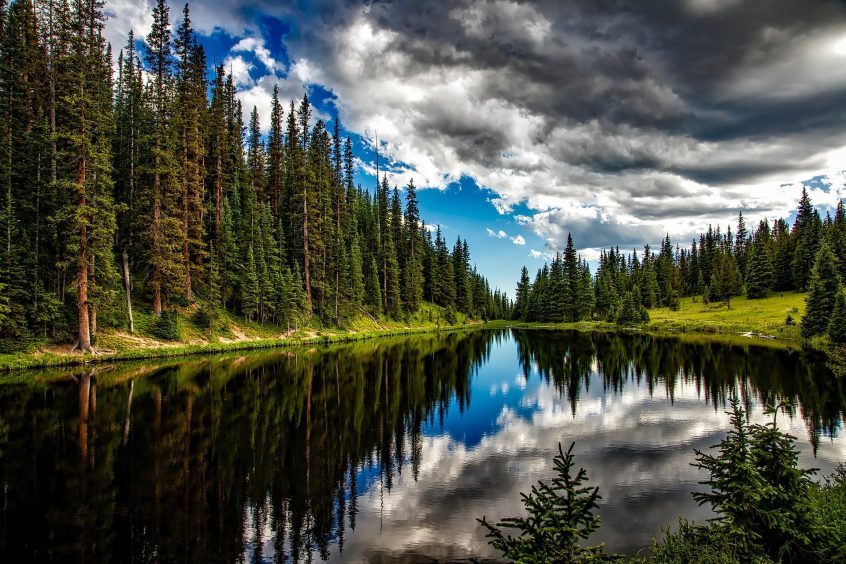
The previous post here ended with the observation, from the 2020 Western Water Assessment Colorado River science study, that around 170 million acre-feet of water fall on the Colorado River Basin – but only 14-17 million acre-feet end up in the actual river. Where does the other 90 percent go? And a corollary question: for such a water-stressed river basin, is there any way to get some of that lost water in the river? We observed earlier that Planet Earth is at just the right distance from the sun for water to exist as a solid, liquid and vapor; recall too that virtually all land-based life depends on it vaporizing from the salty ocean (leaving the salts behind), and then falling over the land as freshwater precipitation, liquid and solid. And the transformations between states are a function of temperature, solar intensity and wind – which means that in a time of rising ambient temperatures, water’s predilection for the vaporous … Read More
Where does our water come from? And what are we doing to it in the Anthropocene?
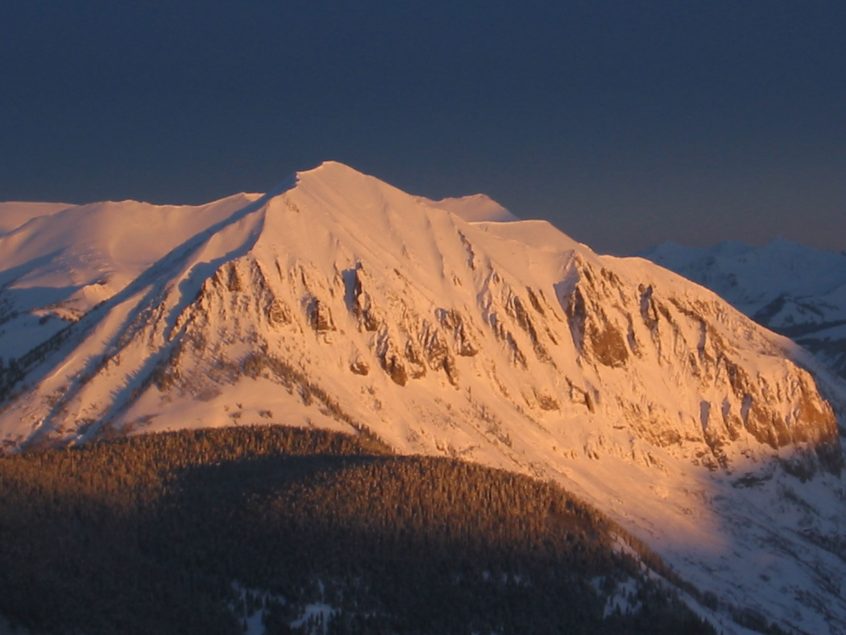
For anyone seeing our planet for the first time from a satellite’s perspective, worries about water might be the last thing to cross their mind. Had we first seen the planet that way; we would probably have named it ‘Water’ rather than ‘Earth.’ Looking at its clouds and ice sheets as well as its expanses of water, we would also see from that perspective that we live on a planet at just the right distance from its star to let water exist in its solid, liquid and vapor states. A few million miles farther from the sun, toward Mars, and our water would all be frozen in its solid state. A few million miles closer to the sun and the water would all be a gaseous cloud mass suffocating the planet. In neither of those situations could life as we know it exist; all life on the planet depends on water in its liquid state – but all land-based life … Read More
A Quick Natural History of the Colorado River
In the last posting, I discussed the great volume of written and visual material that has emerged in recent decades about the Colorado River – First River of the Anthropocene – almost all of it increasingly critical of what we have done with and to the river. It is certainly true that a lot of what we have done reflects poor information and poor planning. We have built storage and delivery systems for a river half-again or twice larger than the River actually was – and it is now diminishing steadily from what it was. And what we have done we can only call ‘anthropocentric’ – something we have to cure ourselves of in the Anthropocene – call it now the Conscious Anthropocene. There is, yes, much to criticize – but then we were not really aware yet that we were in the Anthropocene, and that what we did made differences we needed to anticipate. But lurking behind much of … Read More
The Colorado – First River of the Anthropocene
I said in the first post here that I’ll be focusing on ‘learning to live with the Anthropocene’ – a work-in-progress for everyone who will even acknowledge the existence of the Anthropocene. To refresh your mind on it – the Anthropocene is a new epoch in the evolution of the planet in which the human species is a factor in shaping the planet’s further evolution. This is an ‘honor’ we did not consciously seek – because who would want that kind of responsibility? But we have backed into it, as it were, like it or not – unconsciously, to be sure, and sometimes irresponsibly – but it’s where we are. The Anthropocene follows the Holocene Epoch, which would probably only have been a 20,000-30,000-year interval, plus or minus, of warmth and greenness between epochs of Pleistocene glaciation, had we humans not inadvertently intervened with the advent of the Anthropocene. If you are looking for possible good news in the onset … Read More
Sibley’s Rivers? What, Why and – Why Not?

The first thing I want to say about ‘Sibley’s Rivers’ is to not be misled by the name; it’s not going to be all about rivers – although because the West will be the locus of focus, the rivers that run through it (or don’t) will be frequent topics. Especially the Colorado River, which is so ominously interesting these days. What you’ll find, should you decide to visit ‘Sibley’s Rivers’ from time to time, is mostly going to be ‘rivers of words’ about learning to live in the Anthropocene. The Anthropocene: this new epoch in the eternal evolution of the planet, precipitated by changes that we humans, purposefully or inadvertently, have imposed on the planet’s basic systems, changes which are now altering the conditions of existence for all life on the planet. Most of the scientific community accepts this as a fact of life we now have to learn to live with, and measure up to. We – all of … Read More
The Day of the Thousand Thousand-foot Waterfalls
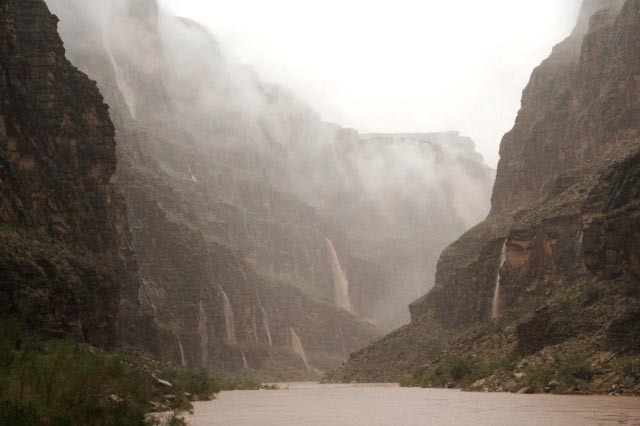
By George Sibley Photo credit: Mark Stemm It was a miserable morning in a transcendent landscape. We huddled in the rafts under a steady businesslike rain, learning about all the leaks in our waterproof gear, while looking out and up to waterfall after waterfall, waterfalls coming freefall in 500 or 1,000 foot leaps over the great limestone walls in the lower Grand Canyon. Shifting convocations of mist, fragments of clouds drifted through and died against the walls; occasionally rocks rattled down the walls, startling us and plopping into the river; but mostly we just huddled stunned by the wet chill and that great gray dream of beauty as hours, miles passed and the waterfalls kept appearing around each turn and bend of the river till we were no longer amazed, and just wondered when or if it would stop raining – but not really hoping for that, knowing that the waterfalls would also stop. We’d been lucky that morning; we’d woken to a threatening sky, but … Read More
Down on the Ground with Sense of Place – at 50 Years
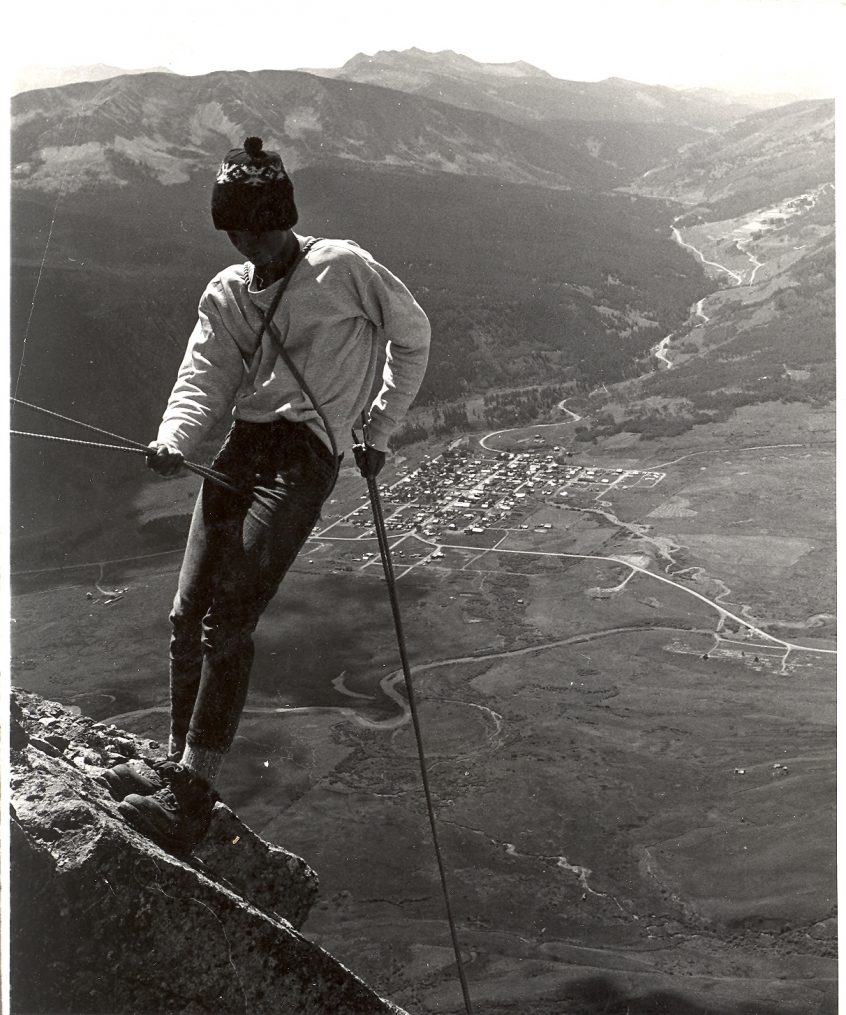
‘Sense of place’ is a term that gets used a lot today, but like all terms that get used a lot, its meaning gets as spread out, shallowed and lost in its own debris as a snowmelt stream in October. Wallace Stegner might be credited with formalizing ‘sense of place’ as a concept; he discussed it in a short essay titled ‘The Sense of Place.’ But he also brought in enough observations from Wendell Berry to think the credit should be shared. Starting from Berry’s observation that ‘you don’t know who you are if you don’t know where you are,’ Stegner charges us all to come to know more deeply where we are – …the kind of knowing that involves the senses, the memory, the history of a family or a tribe…the knowledge of a place that comes from working in it in all weathers, making a living from it, suffering from its catastrophes, loving its mornings or evenings or … Read More
Down on the Ground Among Aspens
Down on the Ground Among Aspens A lot of ‘Indian Summer,’ when you just have to be outside, gets invested in the woodpile. Most of what passes for my adult life, I’ve burned quite a bit of wood, using it for anywhere from 20 to 100 percent of the heat in the motley of places I’ve lived. The 100 percent wood heat was for a 16×20 cabin up in Gothic my family and I lived in as winter caretakers for the Rocky Mountain Biological Lab, quite a few years ago. That was toward the ‘living rough’ end of the civilization spectrum; we had electricity most of the time, but we heated entirely with wood, and our plumbing was a spring about 50 yards from the cabin and an outhouse about fifteen yards from the front door. Four of the best years of my life. The 25 percent wood heat is what we do today, where we live in Gunnison. … Read More
Down on the Ground with the Garden
Published in Colorado Central Magazine August 2020 Down on the Ground with the Garden May and June are dominated here by the garden. “Gardens,” I should say; when we moved into our Gunnison home 20-some years ago, we were unimpressed with the expanse of bad lawn that came with it, and we resolved to annually convert at least 50 square feet of bad lawn to garden space. I lack my partner Maryo’s experience with plants, and undoubtedly some of her dedication – I mean, she grew tomatoes in a community garden in Chicago right by a bus stop, which involved defensive measures like painting the tomatoes with a flour mixture to make them look diseased to random hunter-gatherers. But I signed on as the project heavy-lifter, being no lover of monocultures, and now we have little gardens – some kind of growing together – all over the yard. We have mostly made our average of 50 square feet a year, … Read More
Down on the Ground Hiking with Hobbes
This was written in the summer of 2019 on what turned out to be my last hike with this good friend for many years; he has since, as mountain people are wont to put it, ‘gone on up the mountain.’ Down on the Ground Hiking with Hobbes Sumer is icumen in Loude sing cuckoo! There are unquestionably serious things I could be writing about this month – water management, forest management, Repugnicans and Democranks, et cetera. But it’s summer, peak of summer, and here in the mountains the shortness of the season is countered by its sheer intensity, as if every living thing above 7,000 feet elevation were dropping all other activity in order to raise to the blue morning sky a big vulgar Orffian hymn of rejoicing (Loude sing cuckoo!). I just have to join in. Besides – I have a good ridiculous summer story – one that could only happen (legally anyway) in Colorado and … Read More